Continuing from the last post that presented a summary of our itinerary and covered Days 01 to 07 of our 15-day trip to Japan in December 2022: here is Part 2 that covers Days 08 to 15. A key component of our itinerary in this second half was our usage of the 5 Day Takayama-Hokuriku Tourist Pass. We needed it to cover our journey from Takayama back to Nagoya on Day 13, so had to arrange our itinerary and our visits to the cities of Fukui, Toyama and Shirakawa-Go to fit the duration coverage. If you’re drawing upon the same 5 Day Takayama-Hokuriku Tourist Pass, you’d likely want to just use our below as a source of additional information, as there are a ton of things to do in the cities surrounding Kanazawa that we did not include this time – e.g. visits to onsens.
Day 8 (Kanazawa)
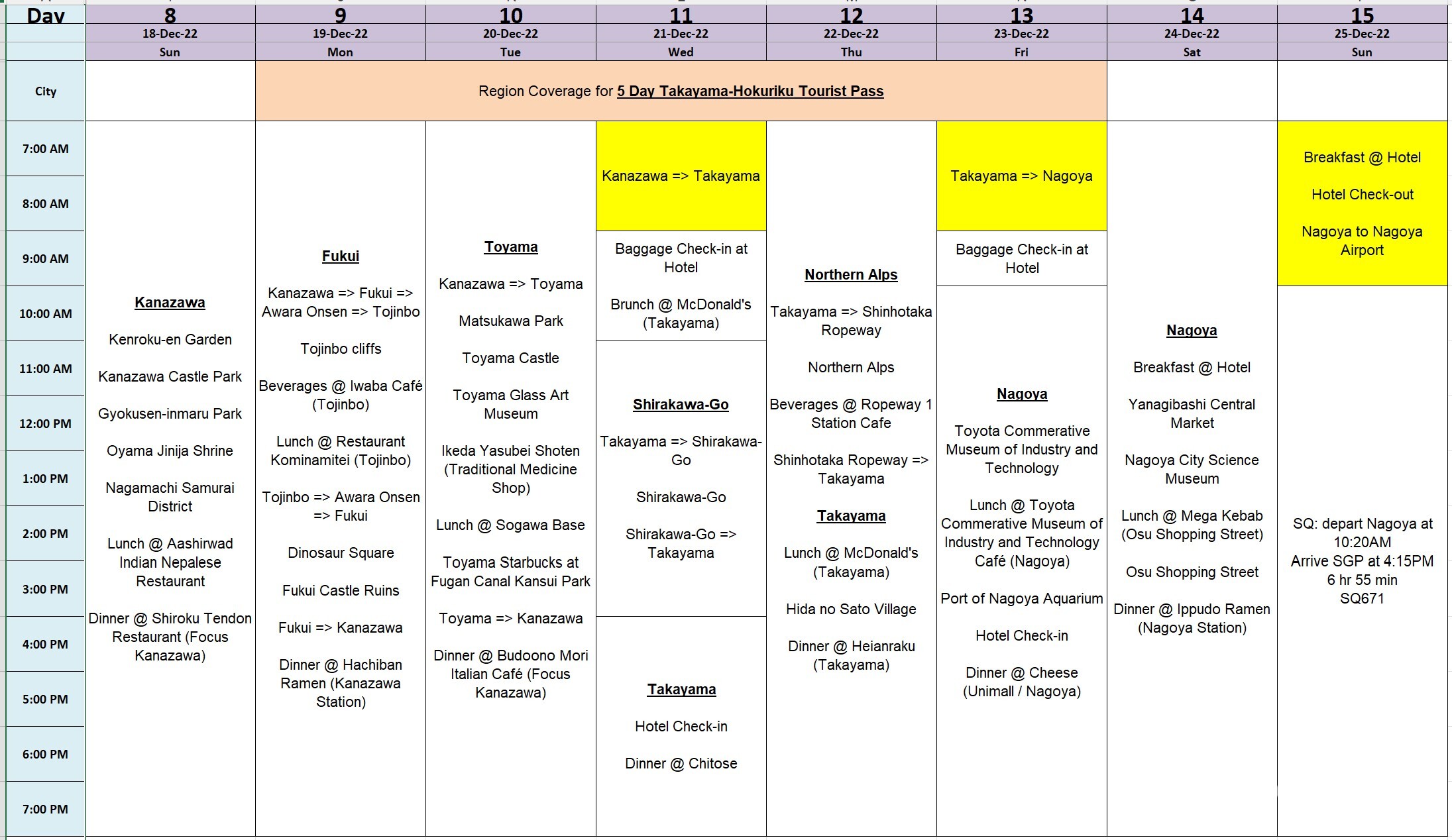
Kenroku-en Garden (2 hrs+) [blog post here]: This is one of Japan’s top three landscaped gardens, and we were hoping to be able to visit this famed place and experience late autumn colors. What we got was a very different experience: snow, hail and rain! But it did make for a very different visual experience compared to the visits to other gardens in the country in our previous trips. The garden is fairly large and you could easily spend 2 hours strolling in it. This garden is also a major tourist spot. But unlike Koraku-en that I visited in 2019, Kenroku-en doesn’t feature the same kind of open garden concept to the same degree, which means you’d be more likely to get photos without too much human traffic. Nonetheless, if congestion bothers you, then this will still be a place that you’d want to time carefully to avoid crowds.
Kanazawa Castle Park (1 hr) [blog post here]: This castle park sits beside Kenroku-en but the busloads of tourists going to the garden don’t seem to stop by this castle park too much. The castle park is worth a quick look for its two turrets at either side of the storehouse and the large open courtyard in front of it, but you’d likely not spend too much time here. Do definitely spend some time taking a look at Gyokusen-inmaru Park though – see next.
Gyokusen-inmaru Park (1 hr+) [blog post here]: This is a lovely but small landscaped garden that’s next to Kanazawa Castle Park. The path that winds inside the garden was closed the afternoon we went by, so we could only observe the park from the teahouse. Pictures of the park make it look like a diorama as it’s really not a big garden, but it’s nonetheless very pretty.
Oyama Jinja Shrine (0.5 hr+) [blog post here]: Across the road from Gyokusen-inmaru Park is Oyama Jinja Shrine. There is a shrine and a small pond with stone steps that’s also worth a quick look.
Nagamachi Samurai District (1 hr) [blog post here]: Another 6–7 minutes’ walk away from the shrine is the old Samurai District. For laymen, the traditional houses here are not too visually different from what we saw at the Higashi Chaya District the previous day. But the area also seems to see far less congestion, so if you’d like a peaceful stroll among traditional wooden houses from the Edo period, this is another option.
Day 9 (Fukui)
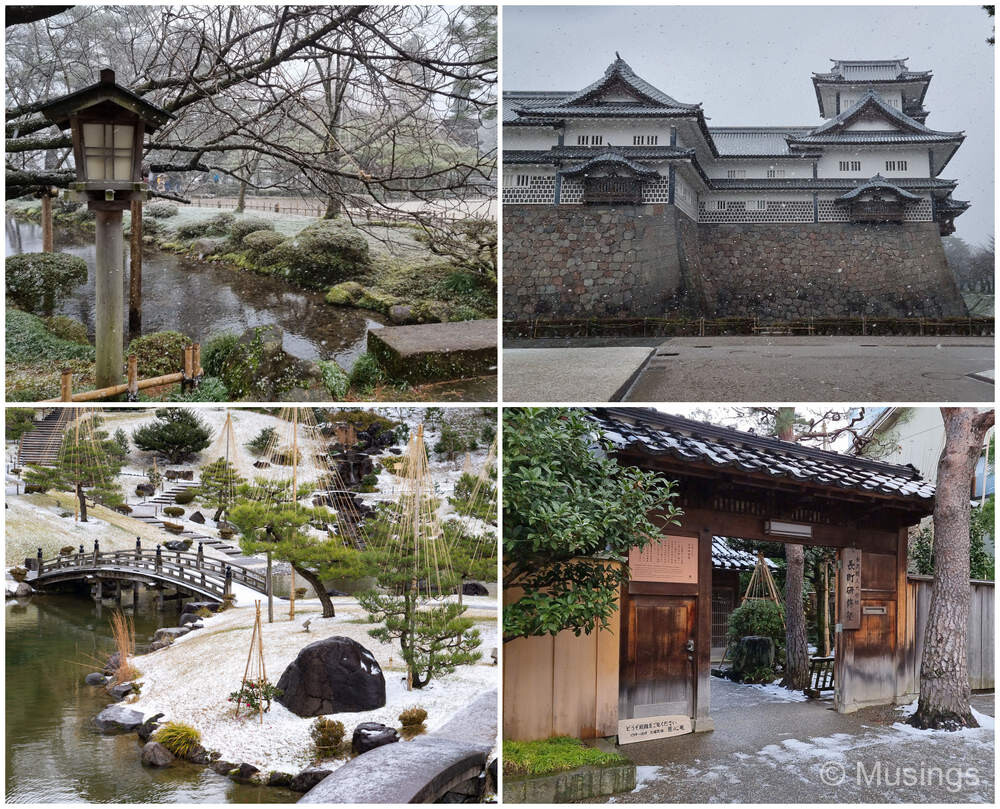
Tojinbo (2 hrs+) [blog post here]: Tojinbo can be reached from Kanazawa by taking a train from Kanazawa Station to Awara Onsen Station, then switching to a 45-minute bus that will take you to Tojinbo, with another bus that can take you back. The one-kilometre-long stretch of rugged cliffs and the Sea of Japan beyond it is without doubt spectacular, but any visit is also subject to the mercies of weather. We faced snow, hail, rain and strong winds the morning we made our way there. The tour boats that bring you to a close look at these cliffs were not running because of the bad weather, and we were equally hit by the strong winds and rain while walking on the marked trails themselves. You’d need to be extra cautious if you’re walking down the trails that lead further down to the cliffs. It looks dangerous enough in good weather – but in wet weather and strong winds, you just might lose your balance and fall into the sea – not before smashing into the rocks!
Near this cliff stretch is also Oshima Island, which we really wanted to visit but could not as the island was closed because of the weather.
Fukui Dinosaur Square and Fukui Castle Ruins (1 hr) [blog post here]: The Dinosaur Square is right outside Fukui train station – you’d almost certainly have to pass it to get anywhere on foot from the station. The square is good for a quick couple of minutes to stop and look at the dinosaur fixtures and pose for pictures, before you’d inevitably want to move on. The Fukui Castle Ruins is another 5 minutes’ walk from the square, and is worth a look for the stone walls and the castle moat – but there isn’t much else there. Earlier versions of our itinerary included a visit to the Fukui Prefecture Dinosaur Museum – but that was closed for the month – and also Eiheiji Temple, but that was dropped because of the snowy weather that day in Fukui.
Day 10 (Toyama)
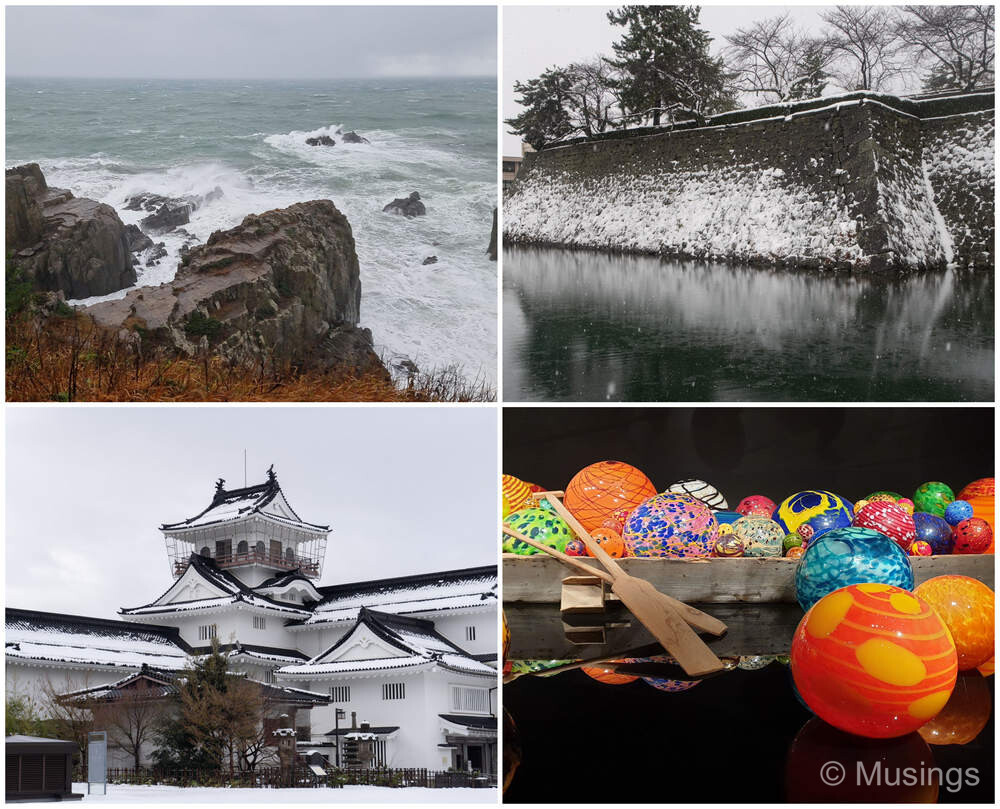
Toyama Castle and Matsukawa Park (1 hr+) [blog post here]: We had a free day to use with the 5-day pass. One option was to visit one of the many onsen towns near Kanazawa, but we didn’t go with that option on account that I wasn’t really keen on onsen experiences. So, we set aside a day to visit Toyama, starting with Matsukawa Park and the reconstructed castle keep. The castle isn’t big but its interior houses a local history museum. We didn’t enter it, and instead had the kids occupy themselves with snow play in the courtyard area in front of the castle. The castle is quite lovely from the outside at least. Do remember to observe the castle from across the pond near the Sato Memorial Museum of Art – it makes for some really pretty pictures.
Toyama Glass Art Museum (2 hrs) [blog post here]: We weren’t expecting much from this museum so were iffy about including it in the itinerary. Boy, were we wrong and later glad we stopped by. The somewhat pricey admission aside if you want to access the special exhibits, the works in this museum were exquisite! The sixth floor is a permanent exhibition of glass artwork by famed American glass artist Dale Chihuly. Even if you don’t have interest in the museum itself, the building where the museum is located is visually stunning. The building also houses the Toyama City Public Library, and the interior’s wood construction is beautiful.
Ikeda Yasubei Shoten (0.5 hr) [blog post here]: This traditional medicine shop is a few minutes’ walk from the Glass Art Museum and can be worth a look if you’re interested in traditional medicines or have an ailment that you want consultation on and can speak the language. We’re neither, but since we were in the vicinity we went by to take a look. You can skip this if you’re pressed for time.
Starbucks at Fugan Canal Kansui Park (0.5 hr) [blog post here]: The Starbucks facing Kansui Park looked glorious in pictures. In non-winter that is! The park felt drained of colour the day we visited. But Starbucks is Starbucks, and there’s no reason not to take advantage of the healthy exchange rate from SGD to Japanese Yen and enjoy your Venti drinks that are cheaper in Japan than in Singapore. This outlet has alfresco seating outside, though the café itself is somewhat small.
Day 11 (Takayama – Shirakawa-Go)
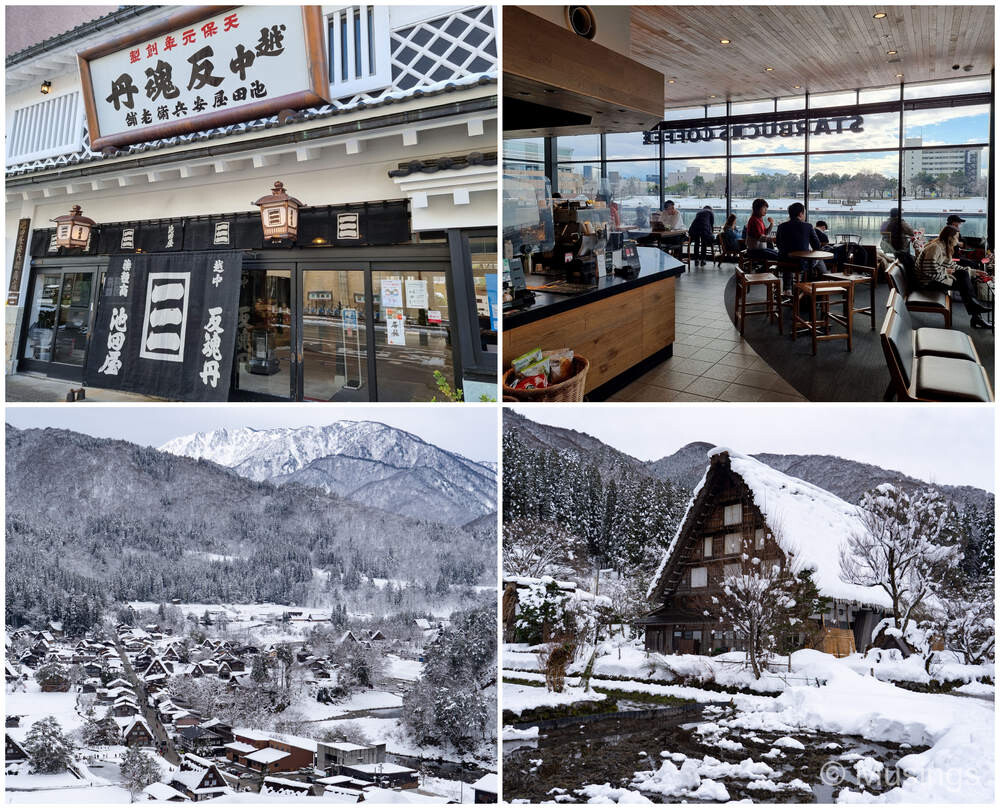
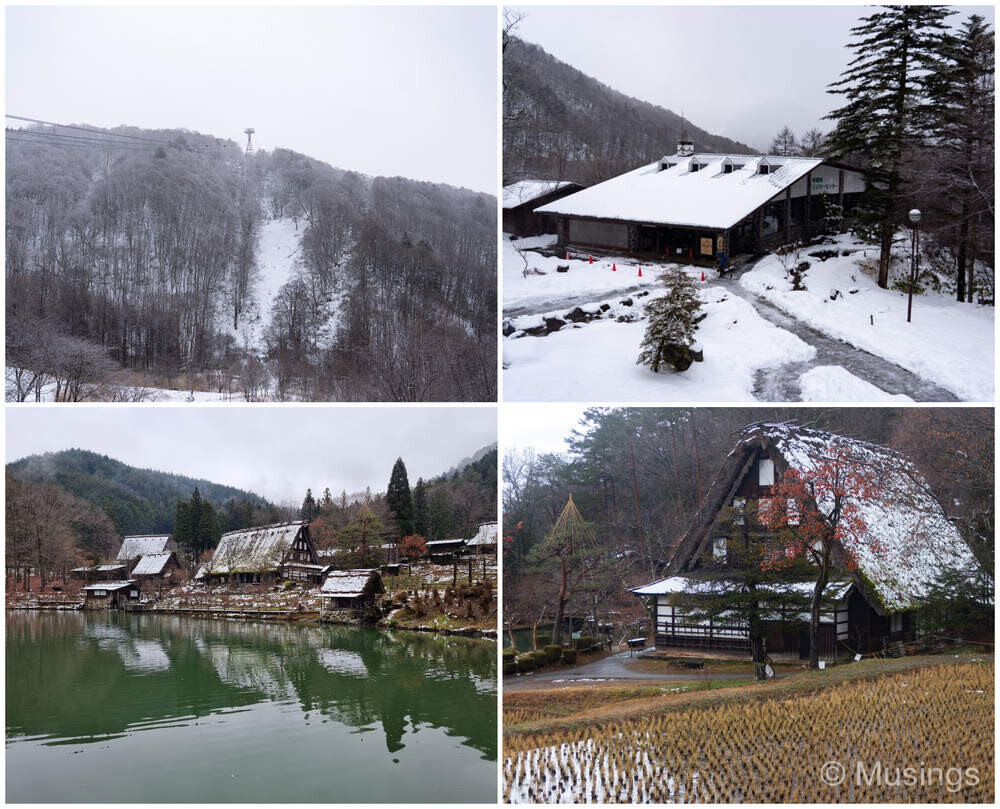
Shirakawa-Go (3 hrs+) [blog post here]: Between Shirakawa-Go and Hida no Sato Village, try to visit both! As much as a learning experience Hida no Sato provides for a single admission fee, the view from Shiroyama Viewpoint of the Ogimachi village in Shirakawa-Go is where you can witness that fabulous panorama and replicate fairly easily those touristy pictures of the place. The village is a major tourist attraction, so be mentally prepared for crowds, especially when it’s time to leave. Keep in mind the time of your intended departure, reserve your bus tickets at the village’s information office as needed, and take your time. Also note that many museums in Ogimachi village require admission fees.
Day 12 (Northern Alps – Takayama)
Northern Alps (2 hrs+) [blog post here]: In another lesson about how winter can derail even the best-planned itinerary, our visit to see Mt. Hotaka via the Shinhotaka Ropeway turned out to be a bust: we were able to ascend only to Ropeway Station 1 – which doesn’t have much – as the continuing ropeway segment to Station 2 was closed because of strong winds. There really wasn’t much to see at Station 1, and as the lifts were still operating on their fixed schedule, we made do with just relaxing at the station café and enjoying their pricey but yummy curry beef pies. We did catch quick glimpses of the mountain ranges on the bus journey back to Takayama, so it wasn’t a total loss. But if you’re likewise traveling in winter, do try to check whether ropeway segments are closed. It may not always be possible given how quickly conditions can change.
Hida no Sato (2 hrs+) [blog post here]: Hida no Sato doesn’t feature the dramatic observation viewpoints of Shirakawa-Go, but for the price of a single admission the compound’s 30 traditional houses are open for exploration. The houses were relocated from around Gifu Prefecture near Takayama to create this open-air museum in 1971, and it’s well worth spending a few hours learning about the lifestyles and work of the Hida people. The village is within easy reach from Nohi Takayama Bus Terminal and buses run frequently.
Day 13 (Takayama – Nagoya)
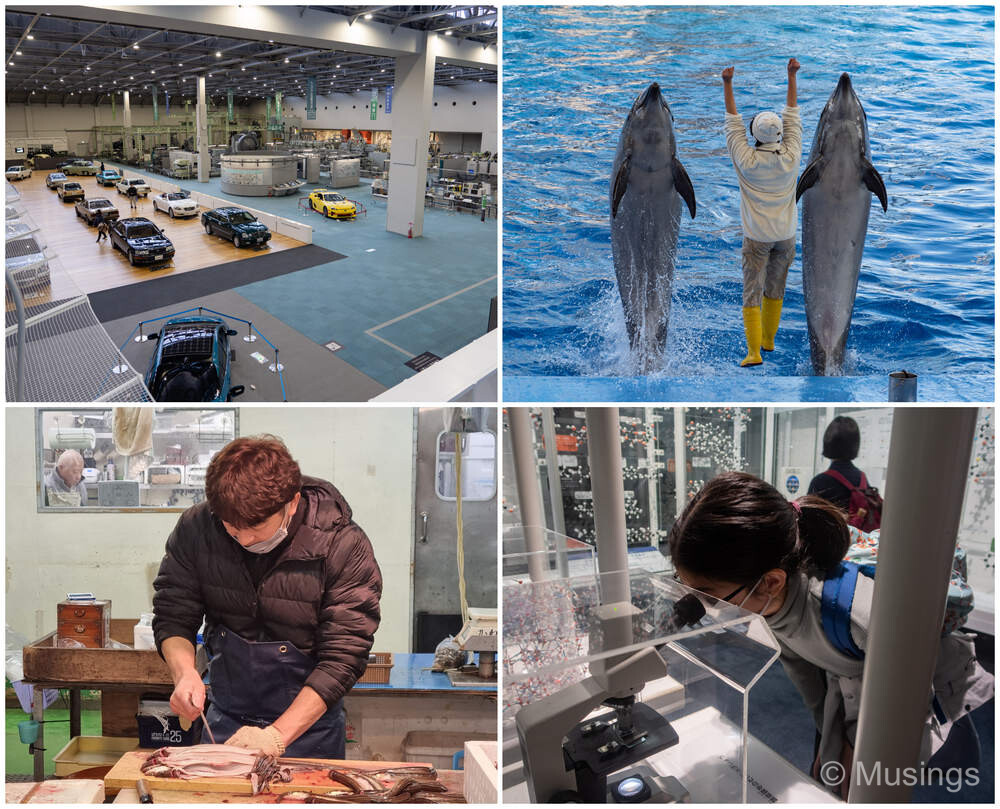
Toyota Commemorative Museum of Industry and Technology (3 hrs+) [blog post here]: This museum has been widely praised for how well it presents the story of one of Japan’s most famous companies – Toyota – and how it began as a textile machinery manufacturer before becoming a global technology powerhouse. The demonstrations are carefully timed so that you can enjoy the hosted exhibitions with time in between to explore on your own. The staff are also really friendly and will approach you to help if you look lost or uncertain. We spent 2.5 hours here and still felt that we hadn’t explored everything.
Port of Nagoya Aquarium (2.5 hrs+) [blog post here]: One of Japan’s better public aquariums. The interiors and themed tanks aren’t quite as modern as some of the newest aquariums elsewhere in the world, but the shows here are spectacular, with dolphins and orcas performing in large water tanks. The Otaru Aquarium which we visited in 2019 had a smaller performance area that made it easier to predict where the next act would occur and was also indoors, providing protection from the weather. The Nagoya Aquarium is in an open-air but sheltered stadium, and it was really chilly the afternoon we visited. There is also an interesting pearl harvesting experience for ¥1,000 that our daughter took part in, and she came away with a pearl necklace.
Day 14 (Nagoya)
Yanagibashi Central Market (1 hr) [blog post here]: I reckon this fresh seafood and produce market won’t be on most visitors’ itineraries. But it’s quite near Nagoya Station, and if you’re looking to visit one while in the city and want something within easy reach, this could be it. Just be mindful – as with all markets – that this place isn’t really geared towards tourists, unlike the Tsukiji Outer Market in Tokyo that we visited in 2019. You can tell from its relative absence of street food stalls and restaurants. So if you’re visiting, try not to be a hindrance to stallholders and locals as they go about their daily business.
Nagoya City Science Museum (4 hrs+) [blog post here]: This was a great visit for us. The museum has multiple levels of exhibits organized by discipline. We spent three hours here and still didn’t see everything the museum had to offer. Some caveats though: the museum is designed for locals, not tourists, which means there is relatively little language support beyond Japanese. We were still able to figure out most interactive exhibits, and the missus – being a science teacher – instinctively recognised many of the underlying scientific principles. The planetarium presentation was a major disappointment for us though, so if you don’t understand Japanese, you may want to skip the planetarium and save the money.
Day 15 (Nagoya)
Flight home to Singapore (6 hrs 55 mins).
—-
And my quick categorization of sights into “Must see/visit”, “Fairly good places”, and “OK to skip/Use as filler” categories:
| Category | Places |
|---|---|
| Must see/visit | Nara Deer Park, Kobe Herb Garden, Koko-en Garden, Arashiyama Bamboo Forest, Kenroku-en Garden, Toyama Glass Art Museum, Shirakawa-Go, Hida no Sato Village, Toyota Commemorative Museum of Industry and Technology, Nagoya City Science Museum. |
| Fairly good places | Philosopher’s Walk, Yoshikien Garden, Todai-ji, Uji-Bashi Bridge, Byodo-in Street, Uji Prefecture Park, Kobe Animal Kingdom, Engyoji Temple, Himeji Castle, Osaka Aquarium Kaiyukan, Osaka Castle Park, Fushimi Inari Shrine, Gion, Higashi Chaya District, Kazue-machi Chaya District, Kanazawa Castle Park, Gyokusen-inmaru Park, Oyama Jinja Shrine, Tojinbo Cliffs, Northern Alps, Port of Nagoya Aquarium. |
| OK to skip/Use as filler | Nagamachi Samurai District, Fukui Dinosaur Square, Fukui Castle Ruins, Toyama Castle and Matsukawa Park, Ikeda Yasubei Shoten, Starbucks at Fugan Canal Kansui Park, Yanagibashi Central Market. |
That’s it for our itinerary and visitation notes as realized in the actual trip. Of note again is that we didn’t get to visit Oshima Island nor reach the summit to see Mt. Hotaka. We also skipped Eiheiji Temple in Fukui, and were content to observe several castles – e.g. Kanazawa, Toyama and Osaka – from just the outside.
Next post will be on interesting flora that we saw in Japan!
Recent comments