I’ve had the Lenovo Yoga Slim 7 Pro for just over three years now, and the machine has served me relatively well over this period: it has a gorgeous OLED screen, a very well-built and sturdy chassis, and also a sleek slim design. However, over the last year, two issues emerged. Firstly, the cooling apparatus in the laptop was no longer working well, which meant that the Yoga would warm up with anything other than the simplest tasks — despite the numerous thermal cleanings I did on the laptop. Secondly, the space bar — that most well-used key on a normal keyboard deck — would frequently not register key presses, which made typing on the Lenovo a pretty frustrating experience.
So, it was about time to look for a replacement. Beyond that, I also needed to find a replacement laptop for the wife’s HP Pavilion Convertible 14 laptop that was of similar age, and also see if I could change my travel laptop. So, this will be a series of three posts on laptop purchases in 2025.
The first laptop to get replaced in 2025 was this Lenovo Yoga Slim 7 Pro, and there were a lot of options available! My requirements for this year were:
Running on either AMD or Intel’s ultra low voltage processors
OLED screen
At least 14″ display
Cool operating thermals
Reasonably long battery life of > 8 hours under normal office productivity use
Storage wasn’t really a concern, since I was pretty sure I would be able to self-upgrade any removable SSD as long as the laptop design permitted users to access its internals. And Windows laptops that offer OLED screens are pretty common today too. No — the real challenge lay in deciding which ultra low power processor to go with, and also ensuring that the laptop would have good thermal management. A number of laptops carried by the major department stores were considered, including the Asus Zenbook S14 and the Lenovo Yoga Slim 7i Aura, but both of them were either pretty pricey and/or were missing one of the key requirements above.
That’s when I started looking beyond what was available via local retail and into import models. Generally speaking, apart from the major brand-name laptop manufacturers, the smaller Chinese laptop manufacturers don’t have much of a brick-and-mortar presence in Singapore at all. Quite a pity, because there are laptops from Honor, Huawei, and Redmi for instance that I found were well worth consideration.
Eventually after a fair bit of searching, one got shortlisted: the Honor MagicBook Pro 14. I hear you say, “Say what?” Yep, this laptop has just been released for the Chinese domestic market, and from the looks of it won’t be reaching international retail anytime soon. Aside from that, the only information I could find about it were a couple of Mandarin review videos on YouTube. Still, the specifications of this model were everything I wanted, including:
A very recent ultra low voltage processor: specifically the Intel Arrow Lake Ultra 9 285H. The processor isn’t the best in class, but still a decent enough performer and achieves a good balance of processor power, GPU performance, and power draw.
32GB of RAM — my first machine, laptop or PC, with 32GB RAM
14.6″ OLED screen, 3120×2080 pixels, 700 nits of brightness, and a 3:2 aspect ratio — the display ticks off every box I needed, and as a bonus is touchscreen-enabled too.
1TB SSD — which users can easily replace if needed. But even better, the laptop has a second NVMe SSD slot too.
Massive 92Wh battery
As well-built and rigid as the Lenovo Yoga, and almost to the same level as a MacBook
2 USB-C and 2 USB-A ports, though the port types are grouped exclusively on each side of the laptop. I would have preferred a more balanced distribution though — i.e. one USB-C and one USB-A on each side.
The price of this lovely machine was SGD1,582 after applying some reseller discounts. It took exactly a week to arrive from the point of order through a Shopee importer of these Chinese laptops from their Hong Kong warehouse to delivery at home.
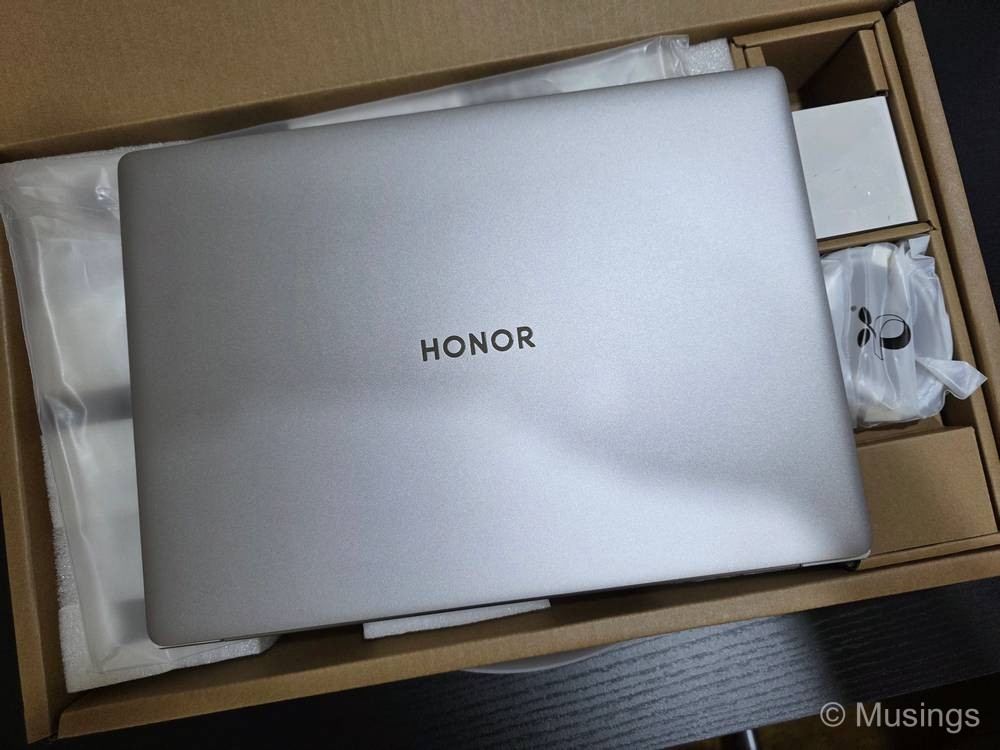
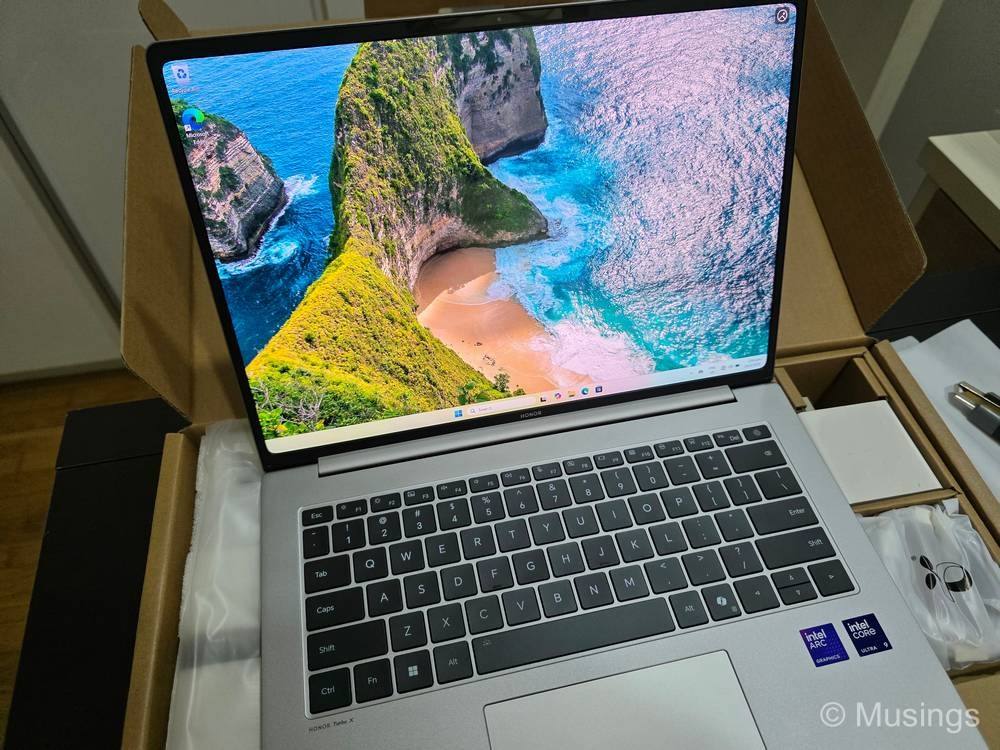
I’ve been using this MagicBook Pro 14 for two weeks now, and have been very impressed by its performance and handling. Beyond the specifications, the MagicBook — amazingly — runs very cool to the touch even under moderate loads, e.g. with a casual game running in one window and office productivity software in others. The laptop also seems to sip only a very small amount of battery power overnight when in sleep mode. MacBooks of course have had this capability for ages, but this is the first Windows laptop I’ve had that does the same: wake-up from sleep is near instant, and power drain after 8 hours of sleep is around just 1%. Under normal office productivity loads, I can get around 10 hours of use, and about 6 if I have a casual game running somewhere.
A couple of downsides of the laptop though: the reseller was happy to install Windows 11 Pro on it and switch it to English language, but there are still a few trace elements of Mandarin here and there lingering around. Also, if the machine conks out for any reason, getting support will be a real challenge! Honor has its own laptop management software that comes with the laptop, but there seems to be no power charging control to limit how much charge goes into the battery in order to extend its longevity. Lastly, its weight: at 1.39kg, it’s no longer in the ultra-portable category, but this isn’t intended to be a travel laptop, so it’s something I can live with.
Still, for what I paid, this laptop is a steal for its specifications, design, and overall handling. Equivalent laptops from the brand-name manufacturers sold here in Singapore would have cost at least $2.5K. Hopefully it’ll last as well in the coming years.
The second laptop I picked up in the last month was a Lenovo IdeaPad 5 2-in-1. Continued in the next post!
⛔ Unfortunately, it’s the end of the road for this laptop in the 🇬🇧 UK as it has now officially discontinued. Confirmation in this email I received below from Honor UK. 😫
Dear Ryan,
We hope this email finds you well. Thank you for your understanding and patience.
We regret to inform you that the HONOR MagicBook Pro 14 2025 will no longer be available for purchase on our eshop and will not be returning to stock in the future.
We understand that this may not be the news you were hoping for, and we sincerely apologize for any inconvenience this may cause. We would kindly recommend exploring our latest HONOR laptop models, which include the newest features and improvements designed to provide an excellent user experience.
We appreciate your interest in HONOR products and hope you find a suitable alternative from our latest range.
Should you need any assistance or recommendations regarding available models, please do not hesitate to contact us.