2026 was about the right time for me to replace my 6 year old gaming laptop, the Aero 15 X9 that I purchased in April 2020 during the early days of Covid. Aside from the fact that the Aero 15 doesn’t really handle more recent games well anymore, its charging circuitry completely failed a year ago i.e. I can only power on the laptop when it’s connected to AC. My preference initially was to just refurbish my desktop PC that is in even more dire need of a refresh. But an indicative cost of building up a custom desktop PC rig proved very high compared to what I’d be getting in the new PC, especially considering the rapidly increasing prices of RAM over the last 3 months and that the absurdly high prices of that key component are expected to continue into 2027.
I was already putting together a list of laptops for the daughter who’s starting a new course of studies in April – I eventually got her the Acer Nitro V16 Slim with the RTX5060. So, I needed only to expand my search to include one that would be specific to my needs. No surprises here, but it was:
An OLED screen.
15.6″ display. Not that I absolutely needed a larger screen: but it had to do with the size of the laptop itself. A smaller laptop would not provide sufficient cooling.
RTX 5060, and preferably better. This was the single biggest requirement that I went back and forth on. My baseline was an RTX 5060 with 8GB RAM, but I was also mindful that this new gaming laptop would need to last me another 5 years. And benchmarks were showing that at these higher class GPUs, 8GB GPU RAM was turning out to be the bottleneck in some game titles. There was also the RTX 5070, but that GPU was likewise limited to 8GB RAM. The only option was to bite the bullet and just go with the RTX 5070 Ti and its 12GB RAM.
The RTX 5070 Ti GPU isn’t just incrementally faster than the 5060: it’s significantly faster, and with plenty of headroom too. But this GPU requirement turned out to be quite limiting, as it immediately meant that under-$2.7K laptops would immediately be out of consideration.
Of the couple of models that met or were close to these requirements, most were in the $3.4K range and higher. One model especially caught my eye: the Lenovo Legion Pro 5 RTX5070 Ti variant. The Legion Pro 5 had exactly the CPU I wanted, a fantastic OLED display, and generally solid build quality. The only thing was its price – around $3.4K for the configuration I liked – and also that, like all high performance gaming laptops, it faced thermal challenges when put under stress. It was also the cheapest gaming laptop with the RTX5070 Ti/12GB RAM that I could find. As luck had it, I found a bargain at Harvey Norman’s online store for this very laptop in January, and the price for it during a CNY sale was a few hundred cheaper than normal retail pricing. So, I went right for it.
Five weeks of daily use later, and especially after a fortnight’s worth of MechWarrior 5: Clans at very high visual settings, I’m very happy with it. Sure, the game causes the laptop to expel hot air, but an Ilano gaming laptop cooler pad helped loads. The keyboard is of the usual high quality from Lenovo and similar in tactile feel to their ThinkPads, the OLED display is indeed lovely, and the laptop can also use USB-C charging for lower performance loads.
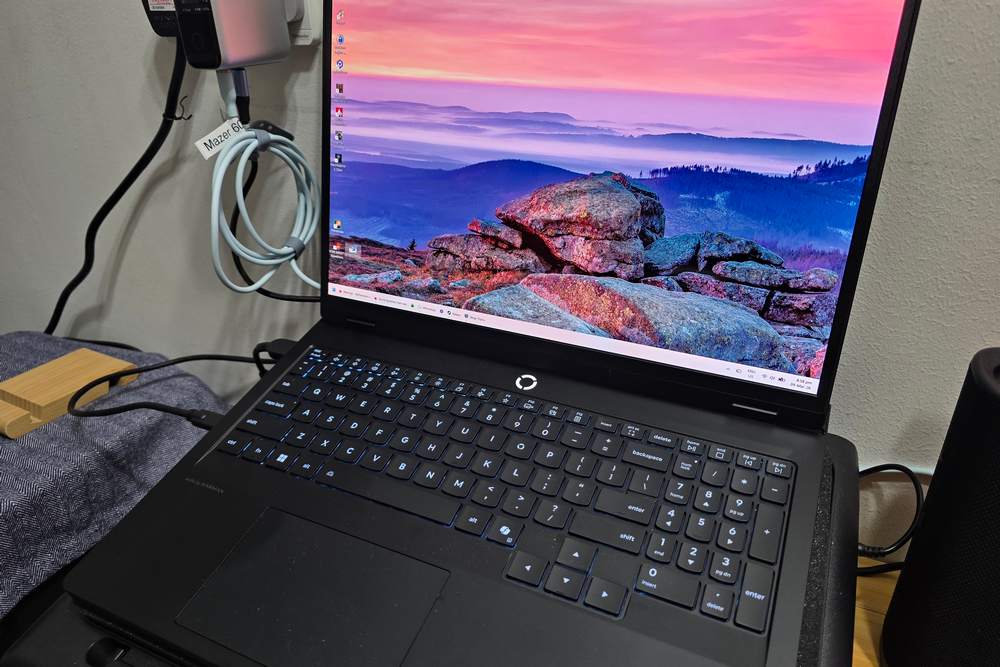
And I’m glad I purchased it in late January at $3.1K. Because today’s pricing is…
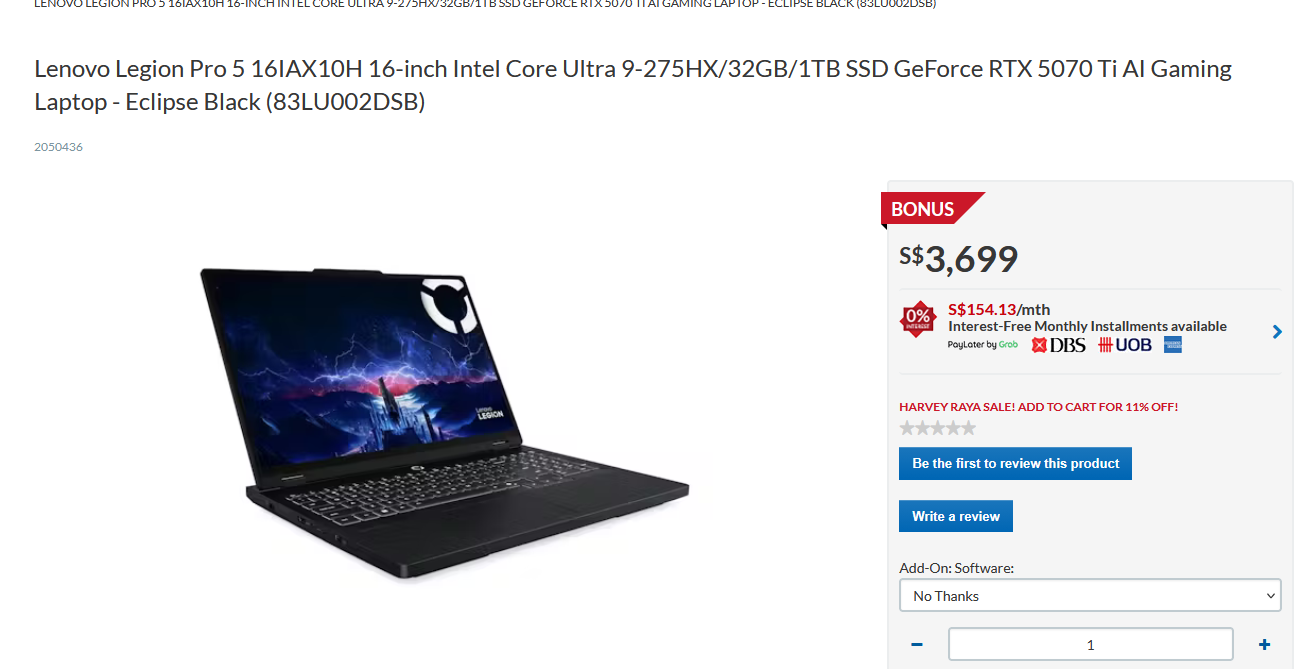
It’s just nuts: laptop models previously never went up in pricing. They always became cheaper because of newer models that come out. But I guess this phenomenon can be attributed to RAM prices going out of whack.